
Mobile signal coverage depends on cell tower components to send data to your phone. Physical barriers or distance can block this signal. When the external connection fails, a mobile signal booster system uses specific hardware components to capture, amplify, and distribute the signal indoors.
How a Cellular Network Operates
Cell networks transmit voice and data using radio frequency waves. A mobile phone antenna connects to nearby cell towers to send and receive these signals. The tower then routes your connection through a central network, allowing continuous communication between mobile devices across geographic coverage areas.
The Tower (BTS) & Network Core
A Base Transceiver Station (BTS) sends the signal directly from your network provider. Located on a cell tower, this hardware converts network data into radio waves. It transmits different types of mobile signals to reach nearby devices within its coverage area.
Core Components of a Mobile Signal Booster System
A mobile signal booster system uses professional cellular repeater components to eliminate indoor dead zones. Excel Solutions (London) Ltd. installs these specialised DAS components to restore weak coverage across homes, offices, and commercial buildings. Here are the core hardware components that make up a complete system.
Outdoor or Donor Antenna
An outdoor or donor antenna mounts directly onto your roof or external wall. Its main job is to catch the weak signal from the nearest cell tower.
Engineers usually install a directional antenna for this task. Unlike an omnidirectional model that pulls signals from all sides, a directional unit points straight at a specific cell tower. This targeted focus gathers a stronger signal, even in areas with poor reception.
The donor antenna then sends this raw frequency down through heavy-duty cable to the internal amplifier. Without a properly aligned donor antenna on the roof, the rest of the booster system cannot function effectively.
Signal Amplifier or Repeater
The signal amplifier, or cellular repeater, acts as the brain of the entire system. This booster unit receives the weak raw signal from the donor antenna and significantly amplifies it.
Inside the mobile signal amplifier, advanced circuitry cleans up background noise while boosting frequency gain. It increases the signal strength, measured in decibels (dB), before sending the boosted signal to internal distribution points.
Proper calibration prevents signal feedback and oscillation between antennas. This process ensures stable voice calls and faster cellular data speeds across all connected devices inside the building.
Indoor Antennas
Indoor broadcast antennas mount on interior ceilings or walls inside your building. These components take the amplified frequency from the repeater and distribute signal coverage across your indoor spaces.
Engineers use an indoor dome antenna on ceilings for full 360-degree coverage in open-plan areas. Alternatively, a panel antenna mounts on walls to push signals down long corridors or through specific rooms.
These antennas broadcast strong coverage directly to all mobile signal devices within range. This layout ensures reliable voice calls and fast data connections throughout the entire property.
Coaxial Cables & Splitters
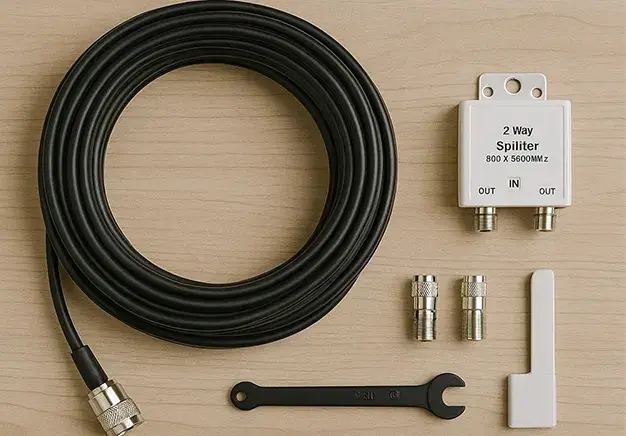
High-quality coaxial cable connects the donor antenna, signal amplifier, and indoor broadcast antennas. This specialised RF cable transfers radio signals between hardware components with minimal power loss. Standard cabling causes heavy attenuation, which weakens the signal before it reaches your phone.
Signal splitters divide the amplified signal when a building requires multiple indoor antennas. A splitter routes equal power through separate cabling runs to extend coverage across several floors or isolated rooms. Using shielded RF cable prevents signal leakage and protects the system from external electromagnetic interference.
How These Components Work Together
A mobile signal booster system uses a four-step process to eliminate dead zones inside your building. Here is how signal boosters work to improve mobile signal coverage:
- Donor antenna catches the signal: The donor antenna on your roof catches the weak radio frequency signal from the nearest cell tower.
- Coaxial cable transfers the signal: Heavy-duty coaxial cable carries the raw signal down from the roof directly into the internal signal booster.
- Amplifier boosts the signal: The signal amplifier processes the frequency, removes noise, and boosts its power significantly.
- Indoor antenna broadcasts the signal: Indoor broadcast antennas distribute the amplified signal evenly across your rooms to connect all mobile devices.
Why Professional Components Matter
Cheap, unbranded boosters bought online often break UK law. Non-compliant units cause network interference, which leads to fines from Ofcom. Excel Solutions (London) Ltd. installs Ofcom-compliant hardware across London to guarantee safe, legal operation.
A commercial mobile signal booster meets strict technical standards set by UK telecommunications regulators. Professional equipment prevents signal oscillation and protects public network infrastructure.
Choosing a certified professional installer ensures your system complies with Ofcom regulations. Commercial-grade components deliver reliable coverage while keeping your business fully compliant with UK law.