
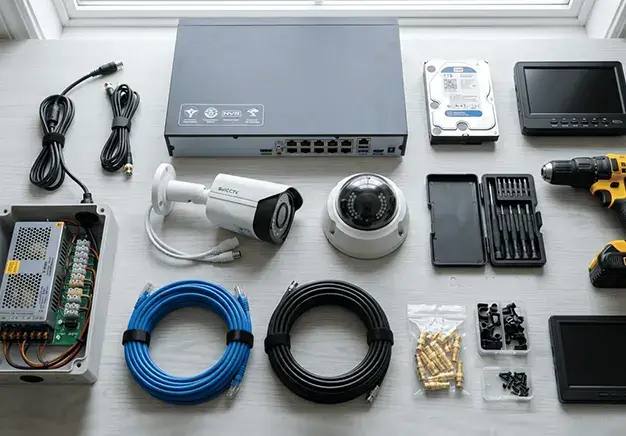
A standard CCTV system requires specific hardware to capture and record secure footage. Core components include high-resolution cameras, digital video recorders, and reliable monitors. These parts connect via specialised cabling to ensure seamless data transmission. Every piece of equipment works together to maintain constant site surveillance.
CCTV Cameras
Cameras act as the primary eyes of your security system by capturing light. These units use advanced lenses to convert visual information into digital signals for recording. You should select specific CCTV types based on your unique environment and lighting requirements for the best results.
Recording and Storage Devices
These devices act as the brain and memory of your security system. They manage incoming data and provide essential CCTV memory for all recorded footage. Most installations typically utilise one of the two following security camera recorders to handle their visual data.
DVR and NVR Systems
The main difference lies in how these systems process your video data. A digital video recorder relies on older analogue technology to encode footage at the recorder. In contrast, a network video recorder works with digital IP cameras that encode data internally. This allows the NVR to manage high-resolution streams more efficiently across your local network. Choosing between DVR vs NVR depends entirely on your existing cabling and required image clarity.
Storage Devices
Reliable security systems require a dedicated surveillance HDD built for constant 24/7 read/write cycles. Unlike standard computer disks, a high-quality CCTV hard drive handles continuous high-definition data streams without failing. Many cameras also support a camera micro SD for local edge storage or use cloud backups.
CCTV Cables and Connectivity
Physical transmission lines serve as the vital link between your cameras and recorders. Proper CCTV wiring ensures that video signals remain stable and clear over long distances. Most professional installations use one of two main security camera cables to facilitate this essential CCTV transmission.
Cables and Wiring Systems
The physical connection between hardware determines the overall reliability of your security network. High-quality cables prevent data loss and maintain a crisp image during live viewing. You must select your CCTV wiring based on the specific distance and camera technology used.
- RG59 Siamese cable remains the standard choice for analogue systems to transmit power and video.
- Modern IP systems utilise Cat6 CCTV cable or Cat5e for high-speed data transfer.
- Poor wiring quality leads to significant video interference and noticeable signal drop-off.
- Using an Ethernet security camera setup ensures the best clarity over longer distances.
Connectors and Interfaces
Connectors provide the secure physical interface between your cameras and the transmission cables. Analogue systems use a twist-lock BNC connector to link coaxial wiring to the recording unit. Conversely, IP cameras require an RJ45 CCTV plug to establish a stable digital network connection. Using high-quality security camera connectors prevents signal flickers and loose connections.
Power Supply Systems
Every security setup requires a reliable CCTV power supply for continuous operation. Most systems use individual 12V camera power adapters or a central CCTV distribution box. Some sites use 24V AC power supplies, especially for PTZ cameras that need higher power output. Remote locations may use battery-powered systems or solar-powered units with backup batteries. These options provide the voltage needed to run cameras, sensors, and infrared LEDs. The next section explains how modern systems simplify power delivery with Power over Ethernet (PoE).
Power over Ethernet (PoE) Systems
PoE technology offers incredible installation efficiency by delivering power and data through a single wire. Using a power over Ethernet switch removes the need for local power outlets at every camera location. This setup simplifies your infrastructure and reduces overall cable clutter. You can explore how this fits into broader CCTV technology options to find the best fit for your site.
Networking Equipment
Modern IP systems require a robust digital infrastructure to function at peak performance. A dedicated IP camera router manages data traffic and assigns unique addresses to every camera on your network. This hardware allows you to access live footage remotely via secure internet connections.
Large-scale installations often utilise a CCTV network switch to expand the number of available connection ports. These switches handle heavy data loads without causing lag or signal drops in your recording. For cameras located in separate buildings, a wireless CCTV bridge creates a stable link without the need for extensive trenching or outdoor cabling.
CCTV Monitors & Display Systems
Professional viewing stations allow security teams to observe live footage with absolute clarity. You should choose a 4K CCTV display to ensure every fine detail remains visible during playback. Most commercial setups require a large CCTV monitor capable of handling multi-channel displays. These advanced screens enable you to monitor several camera feeds simultaneously on a single security camera screen.
CCTV Accessories
The right accessories ensure your system remains stable, durable, and legally sound. Using professional-grade mounting hardware prevents camera shake and provides the perfect viewing angle for your property. Additionally, protecting external connections from the elements is vital for preventing system failure over time.
- CCTV brackets and specialised mounts allow for precise camera positioning and secure attachment to various surfaces.
- A weatherproof junction box shields delicate electrical connections from rain and prevents intruders from tampering with cables.
- Displaying a CCTV warning sign in the UK is a mandatory requirement to meet strict UK GDPR and privacy regulations.
These small additions are necessary for a reliable and compliant security installation.
Choosing the Right CCTV Components
Selecting the ideal components depends entirely on the specific layout and security requirements of your premises. Whether you are securing a large industrial warehouse or a private home, each part must work in harmony to provide reliable protection.
If you require expert guidance, we provide professional commercial CCTV solutions and dedicated residential CCTV services tailored for London properties. Ensuring every camera, cable, and recorder is correctly matched will guarantee your system performs when it matters most. Using a professional CCTV installer ensures your equipment is positioned for maximum coverage and full compliance.