
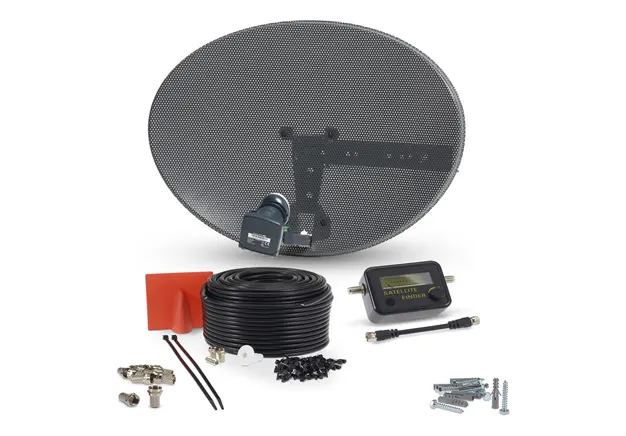
Satellite TV equipment includes the hardware used to receive television signals from satellites. These components form a complete satellite reception system for homes and commercial buildings.
A full system contains a satellite dish, LNB, coaxial cabling, receiver, and mounting hardware. The satellite dish captures signals from orbiting satellites. The LNB receives and converts the signal for transmission through the cable. Coaxial cabling carries the signal to the receiver inside the property.
Each part works together as one system. The quality of satellite dish equipment affects signal strength, reception stability, and long-term performance. Proper satellite system components support reliable television viewing.
Satellite Dishes
Satellite dishes act as parabolic reflectors which capture signals from orbiting satellites. The curved surface reflects signals toward the LNB mounted at the front. This process allows the satellite system to receive broadcast television signals accurately.
Different satellite dish sizes support different signal coverage areas. Standard UK satellite dishes measure about 43–60 cm in diameter. Larger European satellite dishes measure 80 cm or more for wider signal reception. Dish size affects signal strength and reception stability in weaker coverage areas.
Several satellite dish types exist, including fixed dishes and motorised dishes. Fixed dishes point toward one satellite position. Motorised dishes rotate to receive signals from multiple satellites. Satellite dishes are made from steel, aluminium, or composite materials, which affect durability and weight.
Secure mounting supports correct dish alignment and long-term stability. Strong mounting brackets keep the satellite dish fixed during wind and weather conditions. Proper installation protects signal quality and system performance.
LNB
An LNB (Low Noise Block converter) is a device mounted on the satellite dish arm. The satellite LNB sits in front of the dish reflector. It receives signals reflected from the dish surface. The device converts high-frequency satellite signals into lower frequencies for coaxial cables.
The converted signal travels through the cable to the satellite receiver. This process allows the receiver to decode television broadcasts correctly. The quality of the satellite LNB affects signal clarity and system stability.
Several LNB types support different installation setups. A Single LNB connects one receiver. A Twin LNB supports two receivers or two tuner inputs. A Quad LNB connects up to four receivers. An Octo LNB supports up to eight connections. Wideband LNBs operate with modern systems such as Sky Q installations.
Satellite Receivers & Boxes
A satellite receiver processes signals from the satellite dish and displays channels on the television. The receiver decodes the signal received through the coaxial cable. This process converts satellite broadcasts into viewable television content.
Different satellite TV boxes support different services. Subscription boxes operate with paid satellite platforms and encrypted channels. Free-to-air receivers access unencrypted satellite broadcasts without a subscription. Freesat boxes receive UK free satellite channels through the Freesat platform. Some modern televisions include built-in satellite tuners, which remove the need for a separate satellite decoder.
Many receivers also include PVR (Personal Video Recorder) functionality. A satellite PVR box records television programmes on an internal hard drive. This feature allows users to pause, rewind, and schedule recordings of live broadcasts.
Satellite Cables & Connectors
Satellite cables carry the signal from the LNB to the satellite receiver inside the property. Most installations use satellite coaxial cable for stable signal transmission. The cable protects the signal from external electrical interference.
High-quality satellite cable uses a solid copper core and strong shielding layers. These materials support reliable signal transfer and reduce signal degradation. RG6 satellite cable is widely used in residential satellite wiring systems.
F-connectors attach the coaxial cable to the LNB and the satellite receiver. These connectors create a secure electrical connection between satellite system components. Tight and correctly fitted connectors maintain a stable signal flow.
Signal loss increases when satellite cables run over long distances. Poor cable quality weakens signal strength. Water ingress, loose connectors, and poor installation also cause reception problems and unstable satellite television signals.
Satellite Amplifiers & Multiswitches
Satellite amplifiers increase signal strength when cable runs are long or when distribution points increase. A satellite amplifier boosts the signal travelling through the coaxial cable. This equipment supports stable reception across multiple rooms or distant receivers.
A satellite multiswitch distributes signals from one dish to many receivers. The multiswitch connects several LNB outputs and routes signals to multiple satellite boxes. This system supports structured communal satellite distribution.
Multiswitch systems are common in apartment buildings, large homes, and commercial properties. These systems allow many users to access satellite services from one dish installation. Each receiver operates independently within the multiswitch network.
Amplification increases signal strength within the cable network. Dish alignment controls signal capture at the source. These two functions support different stages of satellite signal delivery.
Mounting Brackets & Poles
Secure mounting is critical to keep the satellite dish stable and aligned. Proper satellite mounting brackets prevent misalignment caused by wind or vibration.
Common mounting options include wall brackets, chimney mounts, T & K brackets, and ground poles. Each type suits different building structures and installation locations. Strong mounts resist wind load and maintain long-term stability for consistent signal reception.
Corrosion-resistant materials are essential to protect brackets and poles from rust. Durable satellite pole mounts and wall mount brackets ensure safe, reliable, and lasting dish installations.
Motorised Equipment & Controllers
A motorised satellite system allows the dish to rotate and access multiple satellites. The system includes a satellite dish motor and a DiSEqC controller. The motor moves the dish precisely, while the controller directs it to different satellite positions.
This setup enables one dish to receive signals from several satellites without multiple installations. Motorised systems are more complex than fixed dishes and require careful calibration. Proper setup ensures accurate alignment, reliable signal reception, and seamless switching between satellite channels.
Testing & Alignment Equipment
Accurate signal testing ensures the satellite system delivers stable and clear reception. Satellite alignment tools include digital signal meters and spectrum analysers. These devices measure both signal strength and signal quality.
Signal strength shows the power of the received signal, while signal quality reflects how clear and error-free the signal is. Professional calibration with these tools ensures precise dish alignment. Correct alignment improves reception reliability, reduces interference, and maximises overall satellite system performance.
Choosing the Right Satellite Equipment
Selecting the right satellite equipment depends on several factors. Property type determines whether wall mounts, roof mounts, or ground poles are suitable. The number of viewing points dictates whether a single LNB or a multiswitch system is required.
Deciding between subscription and free-to-air systems affects the choice of receivers and LNB types. International viewing needs may require motorised dishes or wideband LNBs. Consider future expansion potential to ensure the system can support additional receivers or upgrades without major changes. Proper planning ensures the best satellite equipment for reliable, long-term performance.
Frequently Asked Questions
What equipment is needed for satellite TV?
A satellite TV system requires a satellite dish, LNB, coaxial cable, receiver, and mounting hardware.
What does an LNB do on a satellite dish?
An LNB receives and converts satellite signals into a usable frequency. It collects signals reflected from the dish and converts high-frequency signals into lower frequencies. This allows the signal to travel through the coaxial cable to the receiver.
What is a satellite multiswitch?
A satellite multiswitch distributes signals from one dish to multiple receivers. It connects to the LNB and routes satellite signals to several TVs. This allows each receiver to operate independently within the same system.