
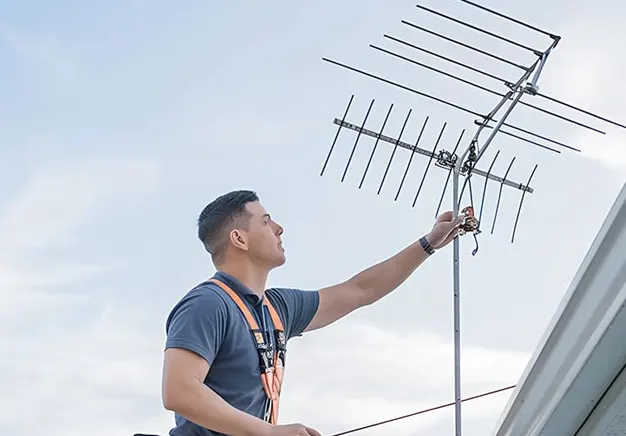
TV aerial alignment is the precise positioning of a television aerial towards the correct broadcast transmitter to receive the strongest and cleanest signal. Aerial alignment, explained in simple terms, means directing the aerial at the right angle and in the correct direction. The aerial must face the nearest suitable transmitter to receive stable digital signals.
TV aerial alignment involves horizontal direction, vertical angle, and correct polarisation. Even a small movement of a few degrees can reduce reception quality. Minor angle differences often cause pixelation, freezing, or missing channels.
Digital television services such as Freeview rely on both signal strength and signal quality. Strength measures how powerful the signal is. Quality measures how clean and error-free the signal remains. High strength with low quality still causes picture breakup.
Correct TV aerial positioning ensures a stable picture and clear sound. If alignment is accurate, channels load consistently and remain reliable during normal weather conditions.
Why Correct Aerial Direction Matters
Correct aerial direction ensures the aerial receives a direct signal path from the broadcast transmitter. Television signals travel in straight lines. They transmit from masts across specific coverage areas. If the aerial pointing angle shifts away from the transmitter, reception weakens immediately.
Many people confuse signal strength with signal quality. Strength measures power level. Quality measures signal clarity and data accuracy. A strong signal with poor quality still causes viewing problems. Digital platforms such as Freeview depend more on quality than raw strength.
Buildings, trees, and uneven terrain interfere with signal travel. Concrete structures reflect signals. Trees absorb signal energy, especially when wet. Hills block direct line-of-sight transmission. These obstacles reduce effective TV aerial direction in the UK.
Poor alignment leads to visible faults. Pixelation appears during weak reception. Channels disappear from the guide. In severe cases, the screen shows “No Signal.” Correct aerial direction prevents these issues and maintains stable viewing.
How to Find the Right TV Transmitter
A TV transmitter is a broadcast mast that sends television signals across a defined coverage area. It distributes digital terrestrial services to homes through radio frequency signals. Your aerial must point towards the correct transmitter to receive stable channels.
The UK has multiple regional transmitters. Major sites such as Emley Moor transmitting station, Crystal Palace transmitting station, and Winter Hill transmitting station serve large populations. Smaller relay transmitters cover rural and coastal areas. Coverage varies by postcode and terrain.
Some locations receive signals from more than one transmitter. Signal overlap occurs in border regions or elevated areas. In these cases, a TV transmitter finder or nearest TV transmitter tool identifies the correct source. Services such as Freeview provide transmitter lookup tools based on postcode data.
Choosing the wrong transmitter results in missing channels or incorrect regional programmes. The television may store weaker multiplex signals. Channel groups may fail to load completely. Correct transmitter selection ensures full channel availability and regional accuracy.
Tools Used for TV Aerial Alignment
TV aerial alignment can be done manually or by a professional. Manual alignment uses simple tools such as a compass to find the transmitter direction, a signal strength meter to gauge reception, and the Freeview tuning menu to check channel quality. These basic tools are suitable for single-room or straightforward installations.
Professional installers use advanced tools for precise alignment. Digital signal analysers measure both signal strength and quality across multiple frequencies. Spectrum analysers detect interference and weak multiplex signals. Using these TV aerial alignment tools ensures optimal reception and reduces the risk of missing channels or having an unstable picture.
TV Aerial Alignment Process
The TV aerial alignment process begins by identifying the correct transmitter for your location using a postcode or transmitter lookup tool. Once identified, the aerial should be positioned at an appropriate height to avoid obstacles and maximise line-of-sight reception.
Next, adjust the horizontal direction of the aerial towards the transmitter. Fine-tune the tilt angle to optimise signal quality. Secure the mounting bracket firmly to prevent movement. Check both signal strength and signal quality using a meter or the TV’s tuning menu. Finally, retune the television to ensure all channels are correctly received and stable.
Common Alignment Mistakes
Many TV aerial problems arise from incorrect installation or rushed alignment. Even small errors in direction, height, or placement can cause missing channels, pixelation, or unstable signals. Being aware of common mistakes helps ensure a clear and reliable picture.
- Guessing direction without checking the correct transmitter can lead to missing channels or poor reception.
- Aligning the aerial based on a neighbour’s setup may fail due to different house positions or obstacles.
- Over-tightening brackets before testing the signal prevents fine adjustments and reduces signal quality.
- Relying only on signal strength, not quality, can cause pixelation or an intermittent picture even if the signal appears strong.
- Installing the aerial in a blocked signal path, such as behind a chimney, tree, or other obstructions, weakens reception and causes unstable viewing.
Signs Your TV Aerial Is Misaligned
A misaligned TV aerial often causes noticeable signal issues. Recognising these signs early can prevent prolonged viewing problems and help decide if realignment is needed.
- A pixelated or freezing picture appears when signal quality drops.
- Channels disappearing after bad weather indicate the aerial may have shifted.
- “No signal” message shows a complete loss of connection to the transmitter.
- Some channels work while others do not suggests partial misalignment or weak multiplex reception.
- A signal fluctuating at certain times of day can result from interference or incorrect aerial pointing.
Weather & Environmental Impact on Alignment
Environmental factors can affect TV aerial alignment and signal quality. Awareness of these impacts helps maintain stable reception and prevents long-term damage.
- Strong winds moving the aerial direction can shift alignment and reduce signal quality.
- Heavy rain affecting the signal temporarily may cause pixelation or intermittent channels.
- Corrosion weakening brackets reduces stability and can misalign the aerial over time.
- Nearby building developments blocking the signal may obstruct the line-of-sight to the transmitter.
- Tree growth interfering with the signal path gradually degrades reception if not trimmed or avoided.
Signal Boosters vs Proper Alignment
Signal boosters or amplifiers increase the strength of a TV signal but do not improve its quality. They raise the power of whatever signal the aerial receives, including interference or weak multiplexes. If the aerial is misaligned, boosting the signal can make picture issues worse, causing pixelation, freezing, or missing channels.
Proper TV aerial alignment must be corrected before using a booster. The aerial should face the correct transmitter, with accurate tilt and height. Once aligned, a signal amplifier can help maintain signal strength over long cable runs or for multiple TVs. However, boosters cannot fix misalignment or compensate for blocked signals caused by buildings, trees, or terrain.
When to Call a Professional
Calling a professional for TV aerial alignment ensures safer, more accurate, and long-term reliable results. Professional installers have the tools and experience to achieve precise direction, tilt, and height. They can detect interference, test signal quality, and secure the aerial properly to withstand weather conditions.
A TV aerial engineer or aerial alignment service can prevent repeated tuning issues and avoid damage from DIY errors. Professional alignment also ensures stable reception across all channels and multiple TVs, providing peace of mind and consistent viewing quality.
Frequently Asked Questions
How do I know if my TV aerial is misaligned?
A misaligned TV aerial shows pixelation, missing channels, “No signal,” or fluctuating reception.
Can I align my TV aerial myself?
Yes. You can align a TV aerial yourself using a compass, signal meter, and the TV’s tuning menu.
However, professional alignment ensures more accurate direction, better signal quality, and long-term stability.
How can I find the correct TV transmitter for my area?
You can find the correct TV transmitter by using a postcode-based lookup tool. Services like Freeview provide the nearest transmitter for your location. Pointing your aerial to this transmitter ensures full channel availability and stable reception.
Can wind move my TV aerial out of position?
Yes. Strong winds can physically move or tilt a TV aerial, misaligning it from the transmitter. Even small shifts can reduce signal quality, cause pixelation, or make some channels disappear. Regular checks after storms help maintain a stable reception.
When should I call a professional aerial engineer?
Call a professional aerial engineer when DIY alignment fails, for multi-TV setups, or for high or hard-to-reach installations. Professionals ensure safer, precise alignment and long-term, reliable reception.